
Why Your App Is Not Getting Funded: Common Mistakes Startup Founders Make

You have a brilliant app idea; one that you believe could disrupt the market. You may have spoken to potential investors, built early concepts, and started pitching. Yet, funding still feels out of reach.
If this situation sounds familiar, you’re not alone.
Many startup founders struggle to secure investment not because their ideas are bad, but because certain critical factors are missing. Understanding why investors hesitate can help you refine your strategy and significantly improve your chances of raising funds.
Let’s explore the most common reasons apps fail to attract funding; and what you can do to change the outcome.
1. Your Idea Targets a Market That Is Too Small

Investors look for startups capable of generating substantial returns. Even a creative or technically impressive idea may struggle to gain funding if its potential market is limited.
If your app solves a very niche problem for a small audience, investors may worry that revenue opportunities are too restricted.
How to Fix It
- Expand your product’s use case to serve a broader audience.
- Identify additional industries or user segments that could benefit.
- Consider approaching angel investors or smaller funding sources aligned with niche markets.
A focused idea isn’t necessarily wrong; it simply needs a scalable business opportunity.
2. You Lack an “Unfair Advantage”
Investors often ask one important question:
Why are you the right person to build this startup?
An unfair advantage doesn’t mean unethical behavior. It refers to unique strengths such as industry expertise, technical skills, proprietary data, or strong networks that competitors cannot easily replicate.
How to Strengthen Your Position
- Partner with experienced co-founders.
- Join startup incubators or accelerator programs.
- Build relationships with mentors, business communities, or innovation hubs.
Your credibility as a founder is just as important as your idea.
3. Investors Are Not Confident in Your Team
Funding decisions are rarely based on ideas alone. Investors primarily invest in people.
Even great products fail without execution capability, which is why investors closely evaluate the founding team’s skills and experience.
How to Improve Team Strength
- Add technical, marketing, or operational expertise.
- Recruit advisors who bring industry credibility.
- Demonstrate clear role allocation within the team.
A balanced and capable team reduces investor risk.
4. Your Startup Shows No Traction
One of the biggest challenges for early-stage founders is proving demand before receiving funding.
Investors want evidence that users actually need your solution.
Ways to Build Early Traction
- Launch a Minimum Viable Product (MVP).
- Conduct beta testing with real users.
- Collect waitlists, pre-registrations, or early customer feedback.
- Show adoption metrics or engagement data.
Even small signs of user interest can significantly improve investor confidence.
5. You Don’t Have a Clear Customer Acquisition Plan
Many founders assume that a great product will naturally attract users. Unfortunately, investors know that customer acquisition is one of the hardest parts of building a startup.
Simply mentioning “SEO” or “social media marketing” is not enough.
What Investors Want to See
- Defined target audience segments
- Detailed marketing channels
- Customer acquisition cost estimates
- Growth strategy backed by data
A strong go-to-market plan demonstrates business maturity.
6. You’re Treating the Startup as a Part-Time Project
Investors expect commitment. If founders appear only partially invested, it raises concerns about long-term execution.
While leaving a full-time job immediately isn’t always possible, investors prefer founders who show serious dedication.
Possible Solutions
- Transition gradually toward full-time involvement.
- Bring in committed co-founders.
- Build a leadership team handling daily operations.
Your level of commitment signals how seriously investors should take your venture.
7. You Don’t Understand Your Competition
Claiming that your app has “no competitors” is often a red flag for investors.
Every startup competes for user attention – even indirectly.
Competitive Analysis Should Include
- Existing apps solving similar problems
- Alternative solutions users currently rely on
- Pricing models and market positioning
- Your unique differentiator
Understanding competition shows strategic awareness and market readiness.
8. Your Product Need Is Not Validated
Personal belief in an idea does not automatically equal market demand.
Investors want proof that a sizable audience genuinely needs your product.
Validate Your Idea Before Fundraising
- Conduct customer interviews
- Run surveys or market research
- Analyze industry trends
- Test landing pages or early signups
Market validation reduces uncertainty and strengthens funding conversations.
9. Your Financial Projections Are Unrealistic
Overly optimistic revenue forecasts can quickly damage investor trust.
Investors prefer realistic projections supported by data rather than exaggerated growth expectations.
Build Credible Financial Models
- Base projections on comparable startups
- Include operational costs and timelines
- Show clear monetization strategies
- Demonstrate understanding of unit economics
Honest projections signal professionalism and preparedness.
What Should You Do If Investors Say No?
Rejection does not mean your app idea lacks potential. Often, it simply means your startup is not investment-ready yet.
Before approaching investors again:
- Refine your product strategy
- Build traction and validation
- Strengthen your team
- Develop a clear marketing roadmap
You can also explore alternative funding options such as:
- Bootstrapping
- Crowdfunding platforms
- Small business loans
- Strategic partnerships
Final Thoughts
Investors are actively searching for promising startups. Their hesitation usually comes from risk, not lack of interest.
By addressing gaps in market size, traction, team strength, and business planning, you dramatically increase your chances of securing funding.
Remember:
Funding is not just about having a great idea – it’s about proving you can turn that idea into a scalable business.
Ready to simplify your startup equity decisions?
Use our Equity Calculator to instantly evaluate ownership splits, model investment scenarios, and make data-driven decisions with confidence. Start planning smarter equity distribution today.
Got a startup idea but no tech partner?
Create the perfect elevator pitch and attract your co-founder today!


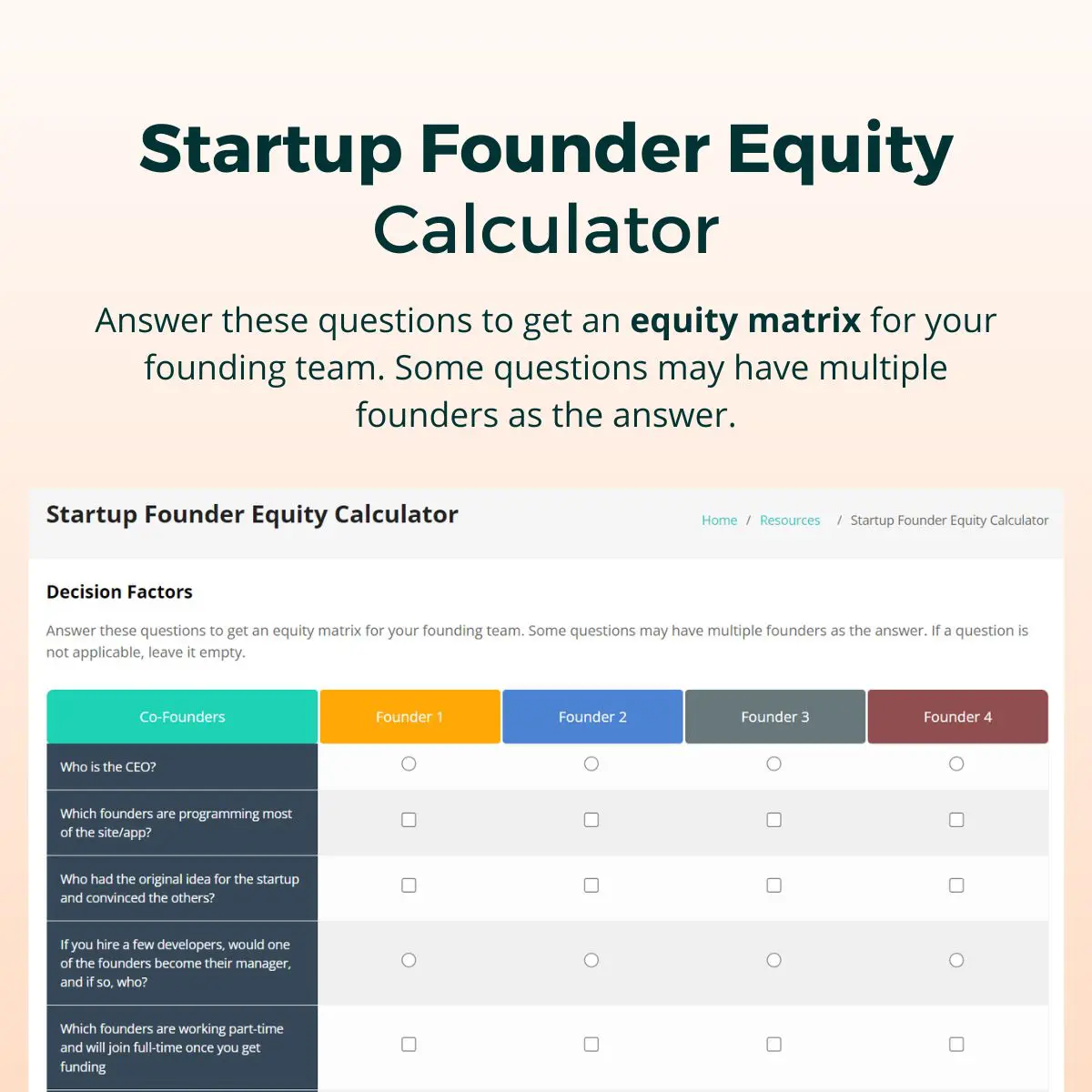
Use Codeventure’s Startup Equity Calculator Today!

