
Equity Calculators vs DIY Methods: Which Approach Works Best for Startup Founders?
Launching a startup involves hundreds of critical decisions, but few are as important as equity distribution. Equity determines ownership, motivates teams, attracts investors, and ultimately shapes the future value of your company.
Founders today often face a key question:
Should you use a startup equity calculator or calculate equity manually using a DIY approach?
Both methods have advantages and limitations. Understanding how each works can help founders make smarter ownership decisions that support long-term growth.
What Is Startup Equity?
Startup equity represents ownership in a company. It reflects the portion of the business held by founders, employees, investors, or advisors in exchange for capital, skills, or strategic support.
Instead of immediate cash compensation, stakeholders receive a percentage of future company value. If the startup grows successfully, equity holders benefit through acquisitions, dividends, or public offerings.
In simple terms, equity is a trade-off:
Ownership today in exchange for future growth potential.
Why Equity Matters for Startups
Equity plays a central role in early-stage companies because it helps:
- Raise capital without immediate repayment obligations
- Attract talented employees when cash flow is limited
- Align long-term incentives between founders and team members
- Reward risk-taking investors and advisors
A well-planned equity structure builds trust and reduces conflicts as the company scales.
Common Types of Startup Equity
1. Common Shares
Common shares are typically issued to founders and early team members. These shareholders usually have voting rights and participate actively in company decisions.
While common stock offers significant upside potential, it also carries higher risk compared to other equity types.
2. Stock Options
Stock options allow employees to purchase company shares at a predetermined price in the future.
Startups widely use options because they:
- Encourage long-term commitment
- Reward employee performance
- Reduce immediate salary expenses
Employees benefit when company valuation increases over time.
3. Preferred Stock
Preferred shares are commonly issued to investors. These shares generally provide financial advantages such as:
- Priority payout during liquidation
- Dividend preferences
- Reduced risk exposure
However, preferred shareholders may have limited voting rights compared to founders.
4. Angel Investor Equity
Angel investors are high-net-worth individuals who invest personal funds into early-stage startups. In exchange, they receive equity ownership and sometimes strategic influence over company decisions.
Angel funding often helps startups move from idea stage to scalable operations.
How Startup Equity Is Calculated

At its most basic level, company equity can be calculated using the formula:
Shareholder’s Equity = Total Assets − Total Liabilities
For example:
- Total Assets: $1,000,000
- Total Liabilities: $500,000
Equity = $500,000
While the formula seems simple, real-world startups deal with complex variables such as funding rounds, vesting schedules, dilution, and valuation changes. This complexity leads founders to choose between automated calculators and manual methods.
What Is a Startup Equity Calculator?
A startup equity calculator is a digital tool designed to estimate ownership percentages and equity value using financial and operational inputs.
Founders use these tools to:
- Model equity splits among founders
- Estimate employee compensation packages
- Prepare for investor negotiations
- Understand dilution scenarios
Advantages of Using Equity Calculators
-> Clear Ownership Visibility
Equity calculators provide structured insights into ownership distribution, helping founders understand how shares are allocated.
-> Data-Driven Decision Making
Automated calculations reduce guesswork by factoring in valuation, vesting periods, strike price, and share count.
-> Fair and Transparent Allocation
These tools make it easier to compare equity offers objectively and maintain fairness among stakeholders.
-> Standardized Methodology
Using consistent calculation models helps avoid emotional decision-making during equity discussions.
-> Ease of Use
Most equity calculators require minimal financial expertise, making them accessible for first-time founders.
Limitations of Equity Calculators
-> Oversimplification
Automated tools may overlook complex business realities such as future funding uncertainty or market shifts.
-> Generic Equity Splits
Some calculators assume standardized founder splits that may not reflect real contributions or risk levels.
-> Lack of Human Context
Factors like leadership ability, commitment level, and company culture cannot be measured mathematically.
-> Static Projections
Equity values constantly evolve, whereas calculators only provide estimates based on current inputs.
What Is DIY Equity Calculation?
DIY equity calculation involves manually determining ownership distribution through discussion, negotiation, and strategic planning without relying on automated tools.
This approach is often used by founding teams during early-stage formation.
Advantages of DIY Equity Calculation
-> Flexible and Customized
DIY methods allow founders to account for:
- Individual expertise
- Time commitment
- Intellectual property contributions
- Risk exposure
This leads to a more personalized equity structure.
-> Strategic Decision Making
Manual calculations encourage deeper conversations about long-term roles and responsibilities.
Challenges of DIY Equity Calculation
-> Time-Consuming Process
Manual equity planning requires extensive discussions, financial modeling, and legal consultation.
-> Risk of Bias or Conflict
Without standardized frameworks, disagreements between founders may arise.
-> Higher Complexity
Managing dilution, vesting schedules, and investment rounds manually can quickly become overwhelming.
Equity Calculators vs DIY Methods: Key Differences
| Factor | Equity Calculator | DIY Method |
|---|---|---|
| Speed | Fast automation | Slower process |
| Accuracy | Data-driven estimates | Depends on expertise |
| Flexibility | Limited customization | Highly customizable |
| Fairness | Standardized | Negotiation-based |
| Complexity Handling | Moderate | Potentially complex |
Which Approach Should Startup Founders Choose?

There is no universal answer. The ideal strategy often combines both approaches.
Use equity calculators when you need:
- Quick projections
- Investor-ready numbers
- Standard valuation models
Use DIY methods when:
- Defining founder relationships
- Evaluating unique contributions
- Making strategic ownership decisions
Many successful startups start with calculator-based estimates and refine equity distribution through collaborative discussions and legal guidance.
Best Practice: Combine Tools with Human Judgment
Equity distribution should never rely entirely on automation or intuition alone.
The smartest founders:
- Use calculators for financial clarity
- Apply human judgment for fairness
- Consult legal and financial advisors
- Revisit equity structure as the startup grows
Balanced decision-making ensures sustainable ownership and minimizes future disputes.
Final Thoughts
Equity is more than numbers; it represents trust, contribution, and long-term vision. Whether you choose an equity calculator, a DIY approach, or a combination of both, the goal remains the same:
Create a fair, transparent, and scalable ownership structure that supports your startup’s growth.
Thoughtful equity planning today can prevent conflicts tomorrow and position your startup for lasting success.
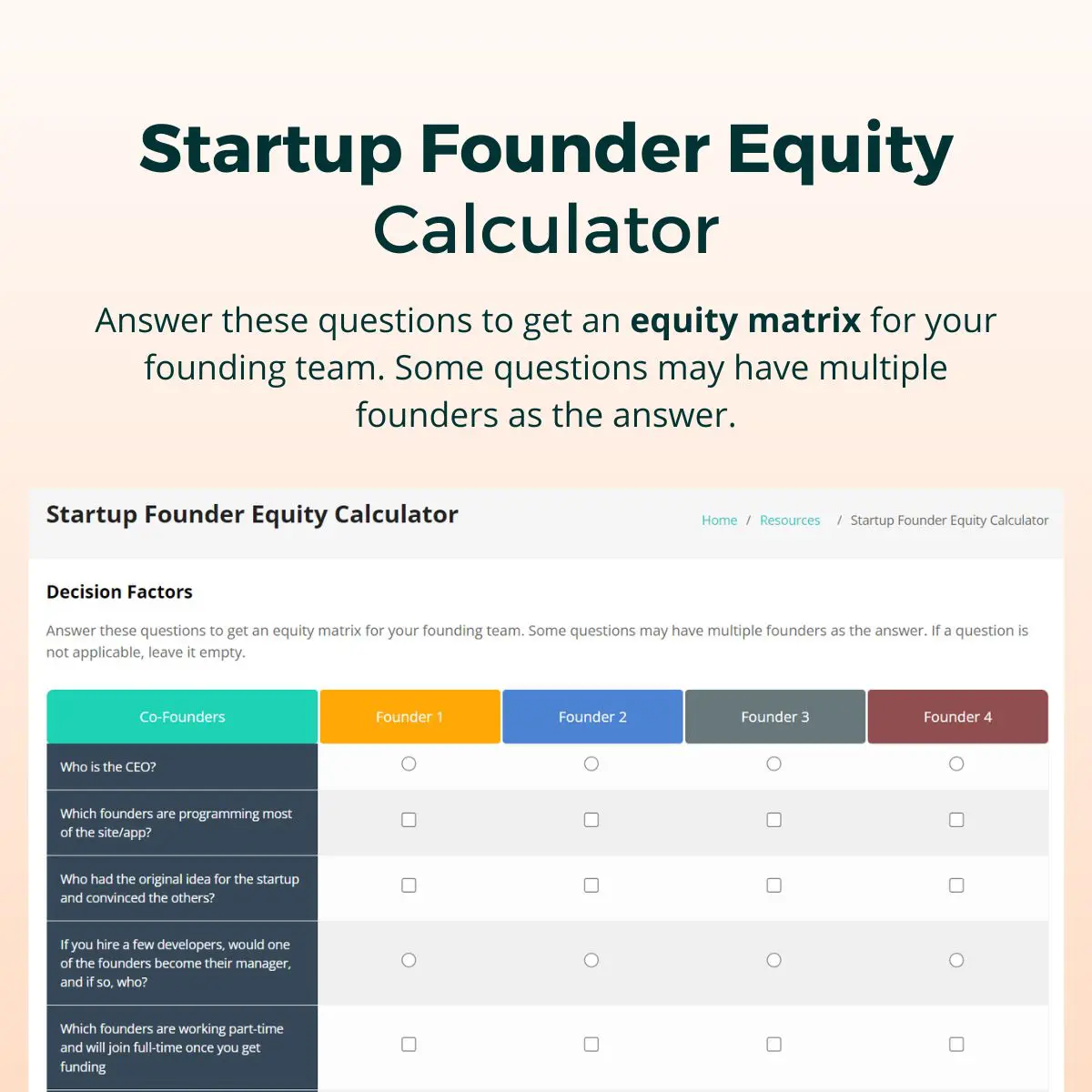
Use Codeventure’s Startup Equity Calculator Today!

