
Startup CTO: Salary and Stock Equity expected at different stages

Getting a Chief Technology Officer (CTO) on board is probably one of the most significant steps a tech startup takes in the initial funding stages. The CTO manages the product and gives it a solid technical direction. They look after product development and oversee the entire project, including creating the plan and finding the resources. For a growing startup, one might even argue that the CTO plays as much or even a bigger role than the CEO.
If a startup has technically sound founder/s, one usually develops business acumen during his startup development and assimilates into the position. However, not all startups have this luxury. 9 out of 10 startups fail, not because their idea was bad, but due to a lack of strategic planning and proper technical execution. This is why most modern startups hire CTOs providing them a salary and a part of the equity.
While parting with equity is not easy for the founders, hiring the right person as the CTO helps them multiply this investment manifold through rapid and precise product development. In the article, we will examine what salary and stock equity CTOs can expect while joining a startup. These numbers consider various factors, including how a CTO is hired, their experience and the region of operation.
What determines a CTO’s salary and equity?
No magic number or equation can be used to determine how much salary or equity a CTO can expect. Depending on the stage of the startup and the roles and responsibilities you have to undertake, the number might be higher or lower. As an aspiring CTO, all you can do is find an average of what people in similar-sized companies are earning and come to a number based on the efforts expected from you.
Experience
With all the roles that a CTO commands, they must have enough years of experience under their belt to bring the best guidance and strategies. Generally, with more experience comes more compensation. However, there are times when seasoned CTOs work full- or part-time for promising startups for less salary in place of higher equity. This is because not all startups have the financial capability to provide C-suite salaries in the early stages. In such cases, opting for higher equity would be much more beneficial considering long-term prospects.
Similarly, suppose you are a technical lead hired in the early stages of startup growth and is being promoted to CTO. In that case, you can typically expect a higher equity share due to your existing relationship with the company and familiarity with the product and roles.

Location and industry
Location is another factor that affects CTO salary and equity. Data suggests that US-based startups prefer to provide more equity and less salary when compared to EU- or Asia-based firms. This could be due to a more matured startup space in the US that values and understands the benefits of equity over salary.
Similarly, the startup CTO compensations for different industries also vary widely. Historically, CTOs in the tech spaces have been compensated manifold over non-tech sectors. However, this trend is changing drastically, with technology slowly creeping into almost every industry.
Startup Roles
The CTO, in their technical capacity, does variety of roles inside the startup, including:
- Building and nurturing the tech team
- Finding the right tech stack
- Managing DevOps
- Performance tracking
- Setting the technical vision
- Bringing innovative solutions
Depending on the scope of the role and expectations, you can increase or decrease your compensation. For example, in early-stage startups, CTO takes on additional roles such as Chief Information Officer or Engineering VP. There are even instances where leading CTOs join the company part-time or provide CTO-as-a-service. The salary and compensation demanded in such cases will typically be lower.
Startup stage
The funding stage of the startup also greatly determines the CTO compensation. If you are joining the company early on (pre-seed) or as a founder, there will be higher equity on the offer and less salary. As the startup moves up the funding ladder, the equity pool reduces, and CTOs should expect more salaries.
In this article, we will concentrate on how the expected salary and compensation of CTOs change through various seed stages of the startup. We have used data from websites like Glassdoor and Payscale, and you should use it for comparison and not as a norm.
Expected CTO salary and equity at different startup stages

If you are a founder-CTO, your compensation is based on consensus with the rest of the founders and investors. You usually have a larger share of the stock and have enhanced roles to play. The salary and equity figures greatly vary from startup to startup and depend on the number of co-founders.
Due to the dynamic nature of founder compensation, this article will focus solely on hired CTOs. Hiring CTO and other C-Suite employees usually start from the seed stage of the startup when some external funding is available. Before this, hiring itself is minimal and existing members typically go on to be the founders.
Seed Stage Startup
Startups in the pre-seed or seed-stage level usually go for a lot of ideation and strategic planning. Technical expertise at this stage is highly valued, but with limited resources at their disposal, CTO are often compensated by higher stock equity.
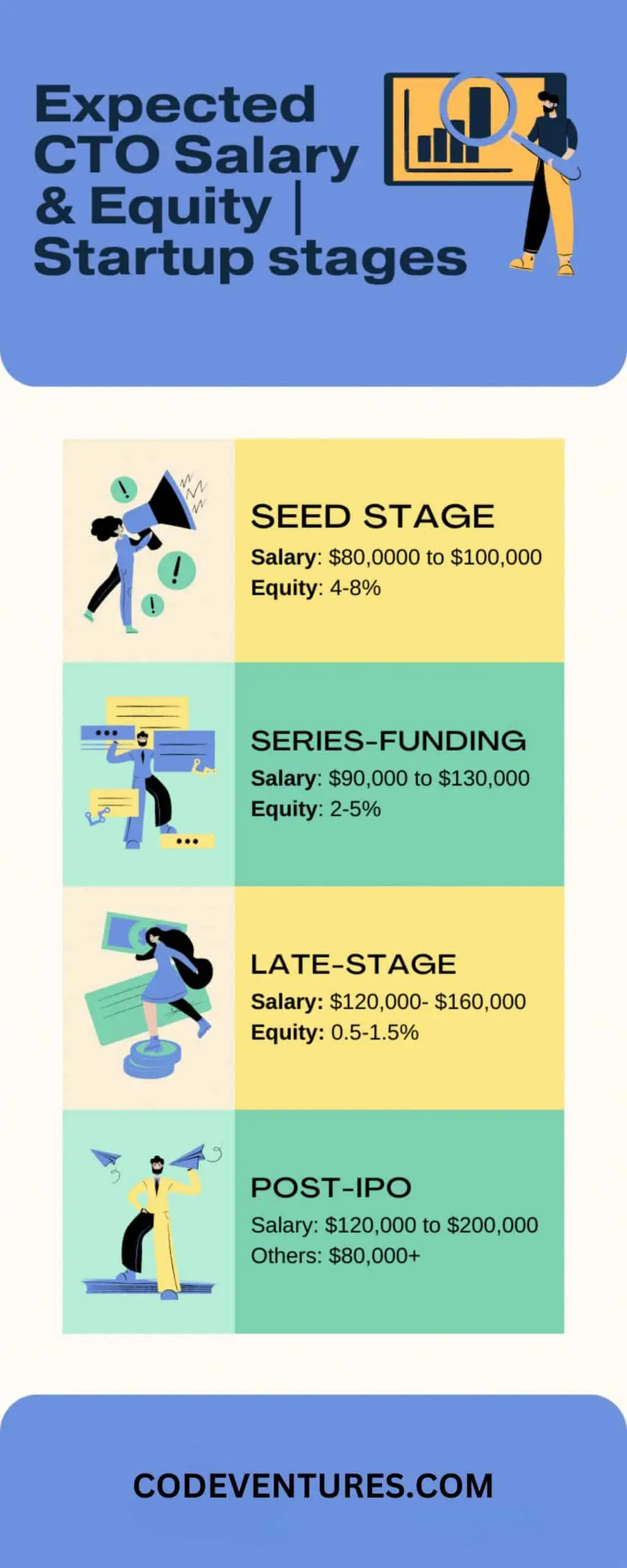
In the USA, the average CTO stock compensation for a startup in the seed stage is 4-8%, while salary ranges from $80,0000 to $100,000. This varies widely across cities, with some cities like Chicago offering 8% over the national average.
Venture growth and Series-stage Startups
As the series-funding stages set in, Startups have enough funds to set out for rapid expansion. They prefer to hire CTOs with good background in running technical operations and, as the company valuation is higher, prefer to pay more salary and less equity.
In the USA, 2% to 5% is the typically expected equity compensation for a CTO joining a startup in the series-funding stage. Salary also gets a jump, with $90,000 to $130,000 expected. Again, the equity starts to decrease as we move up the series-funding stages, A to C and beyond.
Late-stage startups
Late-stage startups have found enough growth and revenues to be financially stable and execute their business plan properly. A CTO is often hired here when the existing CEO and Co-Founders need additional help and expertise in ushering the company to an enterprise level.
Startups in these stages prefer to provide higher salaries ($120,000 to $160,000) and low equity (0.5 – 1.5%).
Post-IPO and other large startups
When a startup has matured enough or has gone public, CTO mostly gets paid in salary. They become similar to large and established companies in this aspect. An average expected salary at this point has high variation, and you can expect anything between $120,000 to $200,000. Stock options are limited- if anything at all, and other compensation is provided as bonuses and profit sharing-usually up to $80,000.

Use Codeventure’s Startup Equity Calculator Today!

Why equity is often more valuable than income in the early days of a business
In the beginning, most of the time, a startup doesn’t have a lot of money. Most businesses are still working on their products, recruiting the appropriate people, and finding the right market. Because of this, young enterprises often can’t pay the high salaries that experienced tech professionals might expect to get in big corporations. Instead, they use shares to hire competent people who believe in the company’s long-term ambitions.
For a CTO who joins a new startup, equity means they own a piece of the company. This means that the company’s growth and rise in value will also help the CTO. If the startup succeeds well, the stock might be worth a lot more than what a normal salary would have been worth over the same amount of time.
Many experienced CTOs are willing to take less money in exchange for a larger share of the company’s stock for this reason. They don’t just see the job as a job; they see it as a chance to build something essential from the ground up. They also have a role in crucial decisions about the company’s technology base, how engineers work together, and product selections because they are on the early leadership team.
But there is always some danger when you accept stock. Not all new businesses get to the latter rounds of fundraising or make money. Honest communication between founders and CTOs is crucial, especially regarding their respective roles, objectives, and long-term aspirations, before settling on compensation. If both parties share a unified vision for the company’s success, equity can serve as a potent incentive, aligning interests and fostering the development of a successful product.
Finding the right balance of business development, leadership, and technology
A startup CTO is in charge of more than just writing code and managing developers. The CTO is one of the most important people who takes decisions regarding the product and technology strategy in many new companies. They are responsible for turning ideas into real, scalable solutions that can help the business grow.
The founders and the CTO work together to plan the company’s technical future. This involves selecting the appropriate technology stack, ensuring the product’s architecture is adaptable, and implementing development methodologies that allow the team to move swiftly while maintaining high standards.
These decisions can have a huge impact on how fast the company grows in the future.
A CTO’s responsibilities extend to the recruitment and hiring of engineers, too. It’s about more than just hiring bodies; it involves setting technical benchmarks and fostering a strong team ethos. A talented tech team does more than just build better products. They also give a company a real edge in a tough market.
As the startup grows, the CTO’s responsibilities often grow even more. They could be involved in meetings with investors, talks about product strategy, and preparing for the future. It is very helpful when working with non-technical founders or stakeholders that they can express complicated technological ideas in a way that is easy to understand.
The CTO is responsible for linking technology and business strategy in many ways. Finding the correct balance between these two areas can help companies produce better goods, obtain more investors, and grow more confidently over time.
CTO Compensation and Equity: What Startups Need to Know
One of the most important things a digital business can do is hire a Chief Technology Officer (CTO). A CTO is in charge of more than just the product. They also define the technical direction, oversee development, and make sure the project goes smoothly from idea to implementation. In a lot of startups, their function might be just as important, if not more so, than the CEO’s.
It may be easy for founders with strong technological credentials to take on the role of CTO. But many businesses don’t have this edge, which is why hiring a skilled CTO may make a big difference. It can be scary to share stock, yet the proper CTO can help your business grow quickly by developing the appropriate products.
The amount a CTO gets paid varies on a number of things, such as their expertise, where they work, the industry, and the stage of the business. To get good workers, early-stage businesses frequently pay less but give out more equity. Later-stage startups, on the other hand, can pay more but give out less equity. For example, U.S. firms usually provide more equity than those in Europe or Asia. This is because the startup culture in the U.S. is more mature and favors long-term rewards.
CTOs have a lot of other jobs besides paying their employees and giving them stock options. They develop tech teams, run operations, set technical strategy, and come up with new solutions. As the startup expands, their effect grows, thus hiring the proper person is very important for long-term success.
