
Founder’s Share Calculator: How much should each founder get?

As a startup founder, one of your most important decisions is dividing up your company’s equity among your founding peers. This decision can be complicated, as there are many factors to consider, such as the experience and contributions of each founder, the amount of funding the company has received, and the company’s future goals.
In this article, we will provide some general guidelines to help you determine how many shares each founder should receive. As a bonus, we even added a link to an innovative startup equity calculator with which you can easily find the shares deserving of each founder. Make sure you read till the end.
Understanding Different Types of Shares
Before deciding the amount of shares each founder should get, you should understand the concept of shares and its different types such as authorized and issued shares.
Authorized shares refer to the maximum shares a startup can legally be allowed to issue based on the charter which is submitted to the concerned statutory body while registration.
For example, Imagine you have a pizza that is cut into eight slices, and you have eight friends over. Each piece represents one share of the pizza. You authorize only 8 slices to be cut, which means you cannot cut any more slices once all eight slices are taken. If you give each of your friends one slice of pizza, you have used up all 8 slices.
You cannot give any more slices to anyone else because you have authorized only 8 slices. However, if you give only 6 slices to your friends, you have 2 slices left to give to anyone else you choose. This is similar to the authorized shares concept, where a company cannot issue more shares than the authorized limit but can issue fewer shares if it chooses to.
Issued shares, as its name suggests, are the authorized shares issued and available to the stakeholders. It is always less than authorized shares. Any issued shares purchased and held by stakeholders are called Outstanding shares.
Additional shares cannot be issued if there are not enough authorized shares. You must amend the corporation’s charter to allow you to issue additional shares which almost always requires approval of majority shareholders or the board. Shareholders are more often reluctant to do this, as increasing the authorized shares allows for issuing more shares, which could dilute the stockholders’ ownership.
How Many Shares Should Founders Get?
The standard for new companies is 8-10 million shares. Authorizing such a large amount makes it unlikely that you will ever need to offer a fraction of a share to anyone.
Consider two startups, Startup A and Startup B. Both have a valuation of $5 million. However, Startup A has issued 100,000 shares while Startup B has issued 10 million shares. This means that Startup A’s shares are priced at $50 each, while Startup B’s shares are priced at just 50 cents each. As an investor, buying shares of Startup B might seem more attractive because of the lower price per share, even though both companies have the same valuation. It also attracts diverse investors and portfolios.
Assuming that a startup has authorized 10 million shares, the founders may be issued up to 7 million shares. This way, even when all the shares have been allocated, the founders will still own the majority of the issued shares.
Determining the ownership percentage for each shareholder is a critical aspect of equity allocation. To accomplish this, you must have information on the total issued shares and the amount of shares that each shareholder holds. Let’s assume that a company has a total of 10 million shares issued, and a founder holds 4 million shares while another holds 2.5 million shares. In this case, the first founder would own 40% of the company, while the second would own 25% (2 million / 10 million x 100% and 1.5 million / 10 million x 100%, respectively).
It’s important to note that ownership percentage can change over time as the company issues more shares or brings on new investors. For this reason, it’s a good idea to revisit the share distribution periodically and adjust it if necessary.
In addition to dividing up equity among founders, it’s also important to set aside a portion of shares for employee incentives. As mentioned earlier, the option pool is typically around 12 to 18% of currently issued shares. This allows the company to offer equity incentives to employees and attract top talent without diluting the founders’ ownership too much.
In summary, deciding how many shares each founder should get is a crucial decision that can impact the success of your startup. While there are no hard and fast rules, it’s generally a good idea to authorize a large number of shares upfront to allow for future growth and fundraising efforts.
Easy Way to Calculate Founder’s Equity
Codeventure’s Founder Equity Calculator is a valuable tool for startups to determine the distribution of shares among founders based on various decision factors. By answering a set of questions related to each founder’s role, contribution, and importance to the company, the tool generates an equity matrix that can be used to distribute shares fairly and avoid conflicts in the future.
This tool is beneficial for early-stage startups that have yet to secure funding or establish clear roles for their founding team. With Codeventure’s Founder Equity Calculator, founders can quickly and accurately calculate their startup shares and focus on building their businesses without worrying about equity distribution.
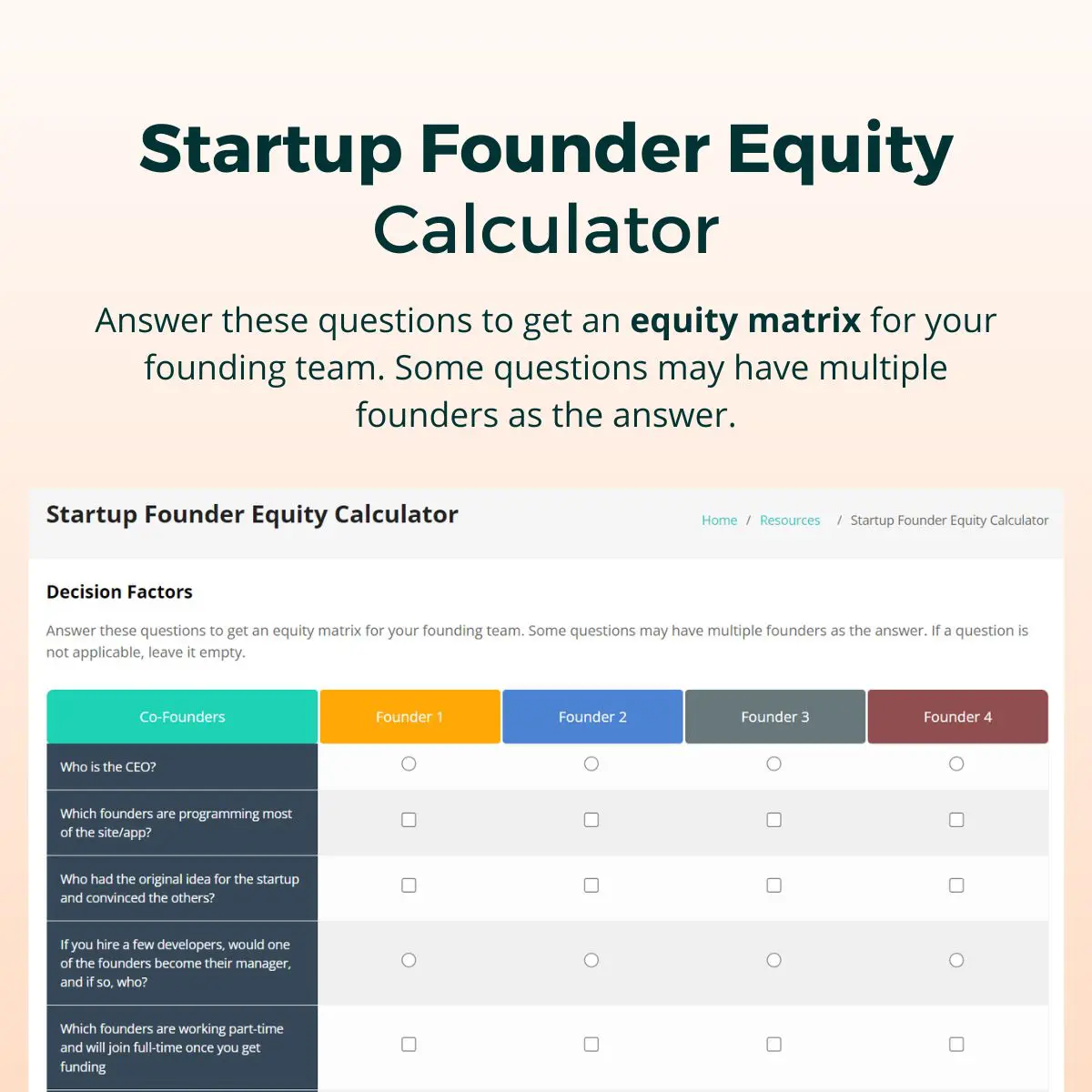
Use Codeventure’s Startup Equity Calculator Today!

How to Fairly Divide Equity Among Founders
When you establish a business with a small group of passionate founders, one of the hardest choices isn’t what to call it or how to make your product; it’s who owns what. Equity isn’t just numbers on a piece of paper; it means ownership, control, and a sense of worth for everyone who is working hard, spending money, and putting up time to help the firm flourish. If you do it well, everyone will be motivated. If you do it badly, it might cause co-founders to be confused, angry, or even tense.
Picture your startup as a huge pizza. The authorised shares are the entire amount of slices that your corporation can legally give out. Each slice you give out is a issued share, which is what a founder or investor really owns. The size of each slice shows how much of the company they own. The pizza is the same, but the way you cut it makes a difference. You could have eight big pieces or ten million small ones. Most new companies give themselves permission to issue 8 to 10 million shares to give themselves some leeway. This manner, there is still room to grow even after giving shares to co-founders, staff, and investors.
It’s not just about slices; it’s also about percentages. If your startup has 10 million shares and one founder owns 4 million of them, that person owns 40% of the company. Another founder owns 2.5 million shares, which is 25%. These figures are important because they impact how much control and voting power each founder has, as well as how much money they will make if the business succeeds. It’s also vital to keep in mind that percentages can alter over time when fresh shares are given to employees or investors. This means that equity should be looked at again and again.
Making Equity Decisions Easier
A wise startup gives staff some shares in addition to the founder’s shares. An option pool of about 12–18% lets you compensate your staff and get the best people without giving up too much of the founders’ shares. This is important for putting together a team that will be motivated and stay together for a long time.
You don’t have to guess to figure this out, thank goodness. The Founder Equity Calculator from Codeventure is one of many tools that make it easy to split shares fairly. The tool makes a clear equity split by asking simple questions about each founder’s role, contribution, and relevance. It helps to make things clear and ensures that everyone knows what their share is right from the beginning. This is very good for new businesses, as you can concentrate on building your business instead of arguing over percentages.
It is an art and a science to divide the equity among everyone fairly. It is about finding a balance between fairness, motivating, and growth potential in the future. Being familiar with shares, stakes, and ownership percentages, as well as using an equity calculator, can save you months of headaches and get your business off to a great start. The team can concentrate on what is really important: building a successful business, where everyone feels that their efforts are valued.
How to Think About Founder Equity in a Way That Feels Fair
There is more to deciding out how many shares each founder should earn than just numbers. It’s about recognizing how much effort, time, and danger each person invests into the business. At first, roles may overlap and contributions may change over time, but being honest about work, responsibility, and long-term commitment makes things simpler for everyone. When founders are honest about these topics, it helps everyone know what to expect and stops fights from happening later.
It’s also very vital to plan for the future. Businesses don’t stay small forever. If you hire essential team members, bring in investors, or grant equity to obtain good personnel, the total number of shares issued will increase up. If founders plan for these changes from the outset, they won’t feel hurried afterward. This way, your business may be adaptable while still understanding how founder ownership works.
Not only do you want to split up the shares, but you also want to build trust. When founders agree on how equity should reflect accomplishments and future roles, it makes the partnership stronger. Taking the time to agree on stock early on makes the company stronger as it grows.
