
Freelancers, Agencies, or a Technical Co-Founder? How to Choose the Right Path
You’ve validated your idea, you know your customer, and you’re ready to build. Then comes the question that stops many non-technical founders: who actually builds this?
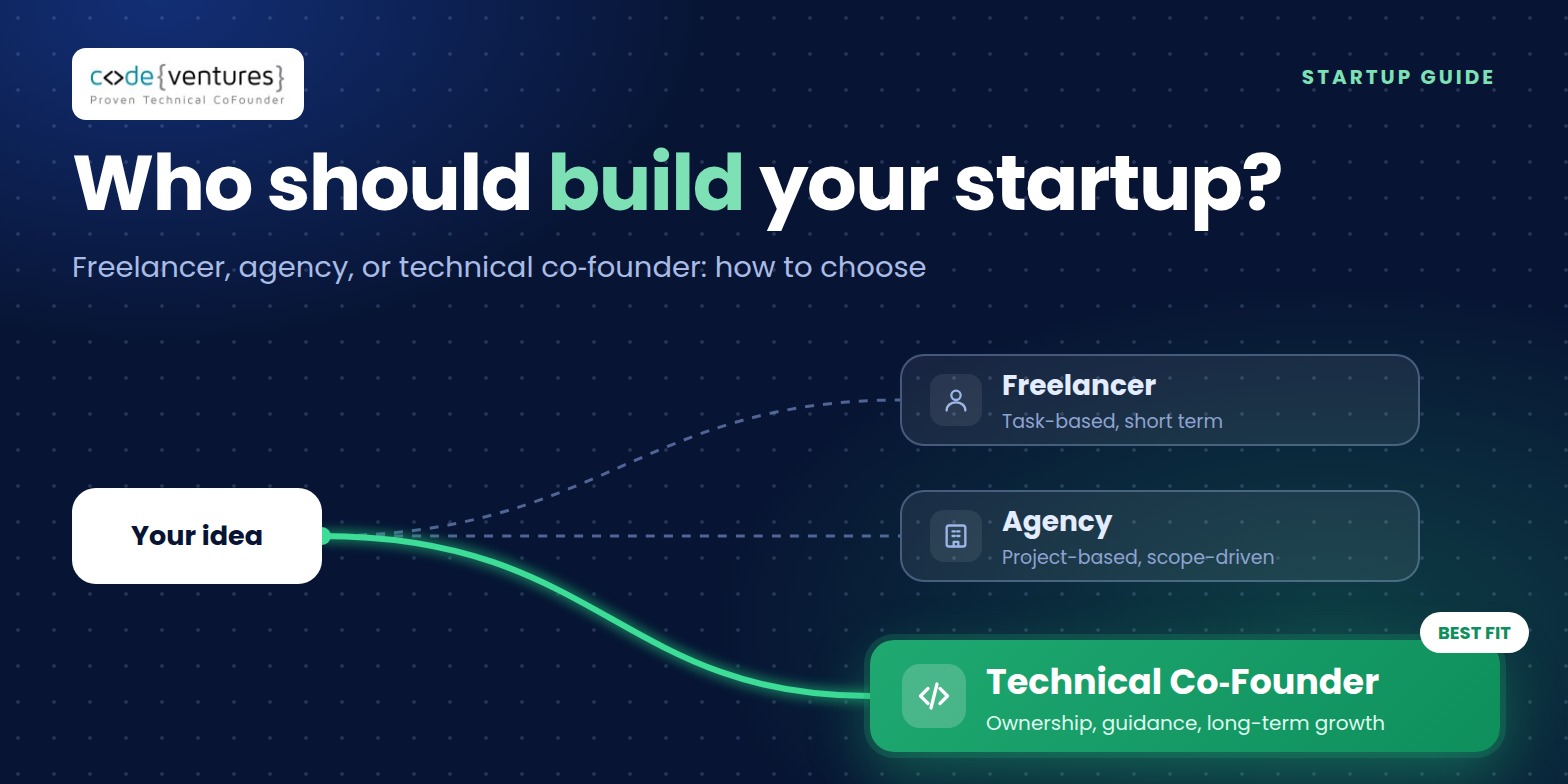
Most founders consider three options: hire a freelancer, hire an agency, or find a technical co-founder. Each can produce a working product. But they differ sharply in cost, risk, accountability, and long-term outcomes, and the choice you make in these early months can shape your startup for years.
This guide compares all three honestly, so you can decide with confidence.
Why This Decision Matters So Much
For a startup, the technology isn’t a side project. It’s the product. The person or team who builds it makes hundreds of decisions about architecture, security, scalability, and cost, and most of those decisions are invisible to a non-technical founder until something breaks.
A poor choice here leads to common problems:
- Rebuilding the product after launch because it can’t scale
- Budget overruns from unclear scope and shifting estimates
- Code you don’t fully control or understand
- Delays that burn through your runway
- Investors asking technical questions you can’t answer
Understanding your options is the first step to avoiding these outcomes.
Option 1: Hiring a Freelancer
Freelancers are independent developers who work on a project or hourly basis. Platforms and referrals make them easy to find.
Where freelancers work well:
- Small, clearly defined tasks, such as a landing page or a simple integration
- Short-term needs with a limited budget
- Adding a specific skill to an existing technical team
Where freelancers fall short for founders:
- Limited ownership. A freelancer builds what you describe. They’re rarely responsible for whether it’s the right thing to build.
- Single point of failure. If your freelancer gets busy, changes jobs, or disappears, your product knowledge goes with them.
- Hard to evaluate. Without technical knowledge, it’s difficult to judge code quality, estimates, or security.
- Narrow scope. One person usually can’t cover product planning, design, development, infrastructure, and security.
- Short-term incentives. The project ends when the invoice is paid, not when your startup succeeds.
Option 2: Hiring an Agency
Agencies offer a team of designers, developers, and project managers under one contract.
Where agencies work well:
- Founders with a well-defined scope and a funded budget
- Projects that need multiple skills at once
- Companies that need a delivery team without hiring staff
Where agencies fall short for early-stage startups:
- Cost. Agency rates are typically higher, which strains early budgets.
- Scope-driven, not outcome-driven. Agencies deliver to a specification. If your idea changes after customer feedback, as early ideas often do, change requests can be slow and costly.
- Relationship ends at delivery. Once the project wraps, the team moves on, and ongoing knowledge may be limited.
- Divided attention. Your startup is one of many clients.
- Transactional by design. An agency succeeds when the project is delivered, not necessarily when your business grows.
Option 3: A Technical Co-Founder
A technical co-founder is a partner who takes ownership of the technology side of your startup. They don’t just write code. They lead technical strategy, make architecture decisions, oversee quality and security, and plan the road-map alongside you.
Why technical co-founders work so well for non-technical founders:
- Real ownership. Their success is tied to yours, so they’re invested in building the right thing, not just finishing a task.
- Strategic technical leadership. They help decide what to build first, what to delay, and which tools fit your budget and growth plans.
- Continuity. The same person or team who built the product stays to maintain and scale it.
- Investor credibility. Investors want to see technical leadership. A strong technical partner makes your startup easier to back.
- Faster, smarter decisions. You have someone to turn to when decisions come up, instead of guessing.
- Plain-language guidance. A good technical co-founder translates technical trade offs into business terms.
The traditional challenge: Finding one is hard. It can take months, requires aligned goals and working styles, and many founders lose momentum while searching. That’s why having access to a proven technical co-founder matters.
Questions to Ask Before You Decide
- Do I know exactly what to build? If your idea is still evolving, you need a partner who adapts, not a vendor locked to a spec.
- Can I judge technical quality myself? If not, you need someone who can be accountable for it.
- What happens after launch? Products need updates, fixes, and scaling. Who handles that?
- Who owns the technical decisions? Someone has to. If it’s no one, problems pile up quietly.
- How will investors view my technical leadership? Early-stage investors often ask who is leading the technology.
- What’s the real total cost? Include rework, delays, and lost momentum, not just the initial quote.
If your answers lean toward “I need guidance, ownership, and long-term support,” a technical co-founder is the strongest fit.
Common Mistakes Founders Make
- Choosing on price alone. The cheapest quote often becomes the most expensive path after rework.
- Treating development as a one-time purchase. Software needs continuous care.
- Skipping technical planning. Jumping straight into coding without architecture and scope creates costly problems.
- Not owning the code. Make sure your code, data, and intellectual property are clearly yours.
- Waiting for the “perfect” co-founder. Months of searching can cost you your market window.
- Starting with a freelancer, then outgrowing them. Many founders switch after the first build runs into limits, paying twice.
Why Many Non-Technical Founders Choose a Technical Co-Founder
Freelancers and agencies can be useful tools. But for a non-technical founder building a company, the biggest risk isn’t a lack of hands to write code. It’s a lack of technical leadership. Someone needs to own the product’s architecture, security, quality, and direction, and be accountable for how it grows.
That’s what a technical co-founder provides. With the right partner, you get strategic guidance from planning through launch and beyond, and you can focus on what you do best: understanding customers, building the business, and growing revenue.
How CodeVentures Helps
At CodeVentures, technical co-founding is our core service. We work alongside non-technical founders as their proven technical co-founder, helping plan the MVP, make sound architecture decisions, build securely, and scale as the business grows. You get technical leadership without the months-long search and without guessing who to trust.
Final Thoughts
Freelancers, agencies, and technical co-founders all have a place. The right choice depends on what you’re building and what you need most. If you’re a non-technical founder who needs ownership, guidance, and a partner invested in your success, a technical co-founder is the strongest path.
Ready to build with a proven technical co-founder? Contact CodeVentures and let’s talk about what you’re building.
