
Equity-Based MVP Development: How Startup Studios Partner with Founders
Having a strong business idea is only the beginning of building a startup. Turning that idea into a working product requires technical expertise, product planning, engineering resources, and a clear understanding of what the market needs.
For non-technical founders, bringing all these capabilities together can be challenging. Hiring an experienced engineering team requires significant upfront investment, while working with freelancers or traditional development agencies may not provide the technical leadership needed to make important product decisions.
This is where startup studios offer a different approach.
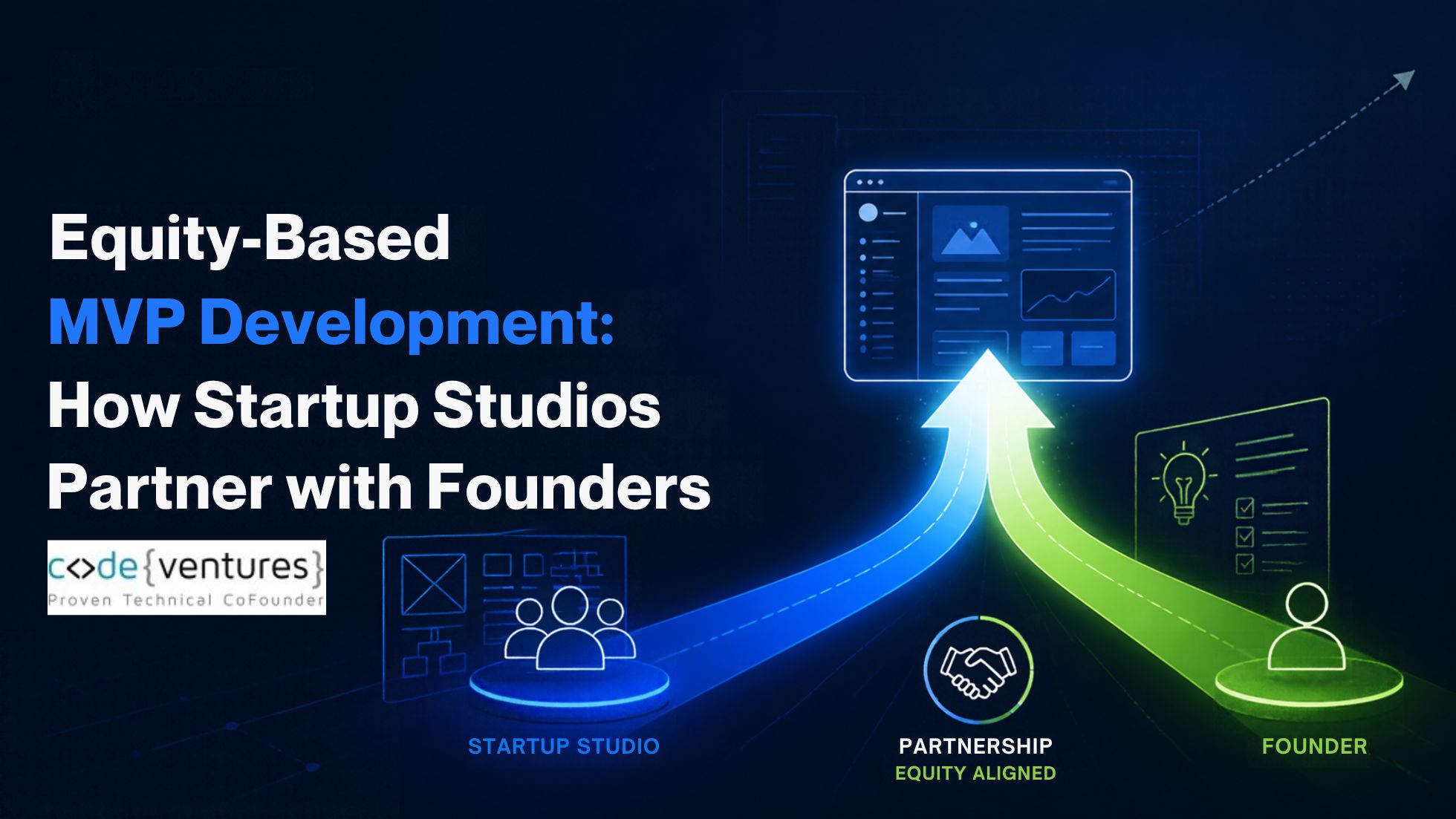
Rather than simply delivering software, startup studios work alongside founders to develop products, establish technical direction, and build the foundations of a business. Through equity-based partnerships and MVP co-development, they can take on the responsibilities of a technical co-founder while founders focus on business strategy, customer relationships, and market opportunities.
The value of this model goes beyond reducing development costs. It gives founders access to an experienced technical partner who shares responsibility for turning their vision into a viable product.
So, how does equity-based MVP development work, and what should founders understand before entering this type of partnership?
Understanding the Role of Startup Studios in Building a Startup
Startup studios, also known as venture builders, take an active role in developing new businesses. They bring together product strategists, designers, developers, and technical leaders to help founders move from an idea to a functioning startup.
Unlike a traditional development agency, which generally works against a defined project scope, a startup studio can become involved in the broader product-building process.
For a non-technical founder, this means having someone who can understand the business vision and translate it into practical technical decisions.
Consider a founder who has identified an opportunity in the healthcare industry. They understand the challenges faced by healthcare providers and have an idea for a platform that could address those problems. However, they may not know how to choose the right technology, design the application, or organize its development.
A startup studio can bridge this gap by providing technical leadership and a product team that works alongside the founder.
The collaboration can involve:
- Product strategy: Defining the problem, understanding customer requirements, and identifying the product’s core value.
- Technical leadership: Making architecture decisions, selecting technologies, and establishing a development road-map.
- Product design: Developing user flows, wireframes, and interfaces that support the intended customer experience.
- Engineering and development: Building the MVP and establishing a reliable technical foundation.
- Launch and growth support: Preparing the product for release, evaluating user feedback, and planning future improvements.
The founder remains responsible for driving the business, while the technical partner takes ownership of the agreed product and engineering responsibilities.
This creates a working relationship in which business expertise and technical expertise complement each other.
How Equity-Based MVP Co-Development Works
Equity-based MVP co-development is a partnership in which a technical team contributes development expertise and resources in exchange for an agreed ownership stake in the startup.
Instead of treating development as a one-time transaction, both parties establish a relationship with shared interests in the product’s long-term success.
The arrangement can reduce the amount of upfront cash a founder needs to commit to product development. However, it does not necessarily mean development is completely free. Some partnerships combine cash contributions with equity, depending on the startup’s stage, product requirements, and level of technical involvement.
A typical partnership involves four stages.
1. Discovery and Product Definition
Before development begins, the founder and technical partner need to establish what they are building and why.
This involves understanding the business opportunity, identifying the target audience, evaluating the problem, and defining the product’s essential functionality.
For example, imagine a founder planning to build a marketplace connecting independent service providers with customers.
The initial concept might include:
- Provider registration and profiles.
- Advanced search and filtering.
- Booking and scheduling.
- Online payments.
- Customer reviews.
- Messaging and notifications.
- Analytics and reporting.
Building every feature immediately could increase development costs and delay the launch.
A technical co-founder helps evaluate which capabilities are essential for the first release and which can be introduced later.
The result is a clearly defined MVP scope that allows the startup to test its core value proposition without investing in unnecessary functionality.
2. Defining the Equity and Partnership Structure
Once the product requirements are established, both parties need to agree on their contributions and responsibilities.
Equity should reflect the value of the technical expertise, resources, time, and responsibilities being contributed.
The partnership agreement should clearly explain:
- The percentage of equity being offered.
- The services and development responsibilities included.
- Any upfront cash contributions or additional expenses.
- Product ownership and intellectual property rights.
- Development milestones and delivery expectations.
- Decision-making responsibilities.
- Equity vesting arrangements, where applicable.
- What happens if either party decides to end the partnership.
For founders, this is an important stage because equity represents a long-term ownership commitment.
A transparent agreement helps both sides understand what they are contributing and what they can expect from the relationship.
3. Building the MVP Together
With the product scope and partnership terms agreed upon, the development process begins.
The technical partner leads the engineering process, coordinates the development team, and makes technical decisions while keeping the founder involved in important product discussions.
This should be an iterative process rather than a situation where the founder waits until the end to see the completed product.
For example:
- The product team creates user flows and design prototypes.
- Developers build the agreed functionality in development cycles.
- The founder reviews progress and provides business feedback.
- The technical team conducts testing and resolves issues.
- Both parties evaluate whether the product meets the intended requirements.
This ongoing collaboration allows the startup to adapt when customer feedback or technical considerations require changes.
The objective is not simply to complete development tasks. It is to build a product that solves a real problem and has the potential to grow.
4. Launching and Preparing for Growth
An MVP launch is an important milestone, but it is not the end of product development.
Once the product reaches its first users, the startup needs to understand how people interact with it, which features provide value, and where improvements are necessary.
The technical partner can continue contributing through infrastructure improvements, technical maintenance, feature development, performance optimization, and guidance on building an internal engineering team.
At the same time, the founder can concentrate on customer acquisition, partnerships, revenue generation, and business development.
This division of responsibilities allows both sides to focus on their strengths while working toward the same business objectives.
Choosing the Right Collaboration Model for Your Startup
Not every startup needs the same level of technical involvement. Some founders are still validating an idea, while others have already identified a market opportunity and need a complete product team.
Startup studios and venture builders can structure partnerships around these different requirements.
Here are three common engagement models.
Early-Stage MVP Partnership
This model works well for founders who have a promising idea and need to validate it through a functional product.
The primary focus is defining the MVP, developing its essential features, and preparing it for initial users.
A technical partner provides the engineering expertise and product guidance needed to move forward without requiring the founder to independently recruit and manage an entire development team.
Turnkey Startup Partnership
For founders with a more developed concept, a turnkey model offers broader involvement.
Along with MVP development, the partnership may include discovery workshops, technical leadership, product planning, launch preparation, and go-to-market support.
This approach is useful when the founder needs a technical co-founder who can take a more comprehensive role in building the startup.
Dedicated Development Team
Some startups already have technical leadership or a defined product road-map but need additional engineering resources.
A dedicated development team provides ongoing technical capabilities for feature development, maintenance, and product improvements.
Depending on the arrangement, this can involve a conventional monthly engagement or an optional equity component.
The important consideration is choosing a model that matches the startup’s current stage, technical requirements, and long-term plans.
Equity-Based Development vs. Traditional Startup Funding
Equity-based development and traditional startup funding both involve exchanging equity for value, but the contributions are different.
In traditional equity funding, an investor provides capital in exchange for ownership. The startup can use that capital for hiring, product development, marketing, operations, and other business expenses.
In equity-based development, the technical partner contributes product development expertise, engineering resources, and agreed technical responsibilities in exchange for an ownership stake.
The founder gains access to technical capabilities rather than simply receiving investment capital.
For early-stage businesses, this distinction is important.
An equity-based development partnership can reduce the initial financial burden of building a product, but it does not automatically provide the working capital needed for marketing, operations, or business expansion.
Founders should consider the complete financial arrangement, including cash contributions, equity dilution, additional expenses, and the responsibilities covered by the partnership.
The objective should be to establish a fair relationship in which the technical partner’s contribution is clearly defined and aligned with the startup’s long-term direction.
What Should Founders Expect from a Technical Co-Founder Partnership?
Choosing a startup studio or technical partner is an important decision. Founders should look beyond development capabilities and evaluate whether the partnership provides the technical leadership their business actually needs.
Here are some important factors to consider.
1. Technical decision-making
Your partner should be capable of making informed architecture and technology decisions based on the product’s requirements, budget, and growth plans. Simply assigning developers to complete tasks is not the same as providing technical leadership.
2. Product ownership and accountability
A technical co-founder should understand the product’s objectives and take responsibility for the agreed technical outcomes. There should be clear accountability for development, testing, deployment, and ongoing improvements.
3. Transparent equity arrangements
Understand how the equity structure works, what the technical partner contributes, and whether additional development costs apply. All terms should be documented before the partnership begins.
4. Consistent collaboration
Product development requires regular communication. Founders should have visibility into progress, technical decisions, challenges, and upcoming milestones.
5. Long-term technical direction
The product should be built with future requirements in mind. Ask how the partner approaches scalability, security, infrastructure, maintenance, and the transition to an internal technical team when needed.
6. Alignment with business objectives
A technical partner should understand the business problem, customer expectations, and market opportunity. Technical decisions should support the startup’s goals rather than focus only on completing development work.
The right partnership brings business and technical expertise together, creating a stronger foundation for the company.
How CodeVentures Partners with Founders as a Technical Co-Founder
At CodeVentures, we understand that non-technical founders often have the business knowledge, industry experience, and vision needed to identify valuable market opportunities. What they may lack is the technical leadership and engineering expertise to turn those opportunities into working products.
We step into that technical co-founder role, bringing product strategy, design, engineering, and development capabilities together to help founders build and launch their startups.
Our process starts with a Discovery Workshop, where we work closely with founders to understand their business concept and establish a practical development plan.
The workshop helps define:
- User flows and essential product functionality.
- MVP scope and feature priorities.
- High-level technical architecture.
- User stories and development requirements.
- Development timelines and technical considerations.
- Business model and initial go-to-market direction.
Based on the startup’s stage and requirements, founders can explore different partnership models.
Early MVP Model
Designed for early-stage founders who need a focused product to validate their business idea.
- Starting at $4,000.
- Estimated delivery in 8–12 weeks.
- Complete managed product development team.
- MVP scope definition support.
- Negotiated equity component of 5–10%.
Turnkey Startup Model
Designed for founders with validated ideas who need broader technical and launch support.
- Starting at $10,000–$20,000.
- Full-time CTO and go-to-market support.
- Discovery Workshop.
- Product development and launch support.
- Approximately 10% equity, subject to negotiation.
Dedicated Team Model
Designed for startups that need ongoing engineering resources and greater control over their development road-map.
- Monthly engagements starting at $3,800.
- Dedicated development resources.
- Flexible team size and scope.
- Assigned project management.
- Optional equity component.
The final scope, costs, timelines, and equity arrangements are determined through discussions based on the startup’s requirements.
Our involvement does not stop at writing code or delivering an MVP. We work with founders on technical direction, product development, and the next stages of their startup journey. As the company grows, we can also help establish or transition to an internal technical team.
The goal is to give founders more than access to developers. It is to provide the technical co-founder-level involvement and product-building capabilities needed to turn a business vision into a sustainable product.
Final Thoughts: The Right Technical Partner Can Shape Your Startup’s Future
Building a startup requires more than an idea and a development budget. It requires people who understand the business opportunity and have the expertise to turn it into a product that customers can actually use.
Startup studios offer a collaborative approach to this challenge by bringing product development, engineering, and technical leadership into the founding process.
Through equity-based MVP co-development, founders can establish partnerships in which technical expertise and business vision work together toward a shared outcome.
However, the value of a partnership should not be measured only by how quickly an MVP is delivered or how much upfront investment is saved. The quality of technical leadership, clarity of responsibilities, and commitment to the product’s long-term direction matter just as much.
For non-technical founders, finding the right technical co-founder can make the difference between having an idea and building a business around it.
Have a startup idea but need the technical expertise to bring it to life?
CodeVentures works alongside founders as a technical co-founder, providing the product strategy, engineering team, and technical leadership needed to move from concept to launch.
Partner with CodeVentures and explore the right development model for your startup.
